Science
Health is one integrated system. We've combined science and technology to treat it as such.
Every feature, recommendation, and insight traces to peer-reviewed research, clinical-grade data, and versioned scientific rules. Every output is deterministic, reproducible, and auditable, meaning the same inputs always produce the same recommendation, and every recommendation traces back to versioned scientific rules and your own data. We integrate multiple biological data streams - continuous wearable biometrics, periodic blood diagnostics, whole-genome sequencing, and annual epigenetic validation - into a rule-based model that interprets each signal's biology in reference to your own body. Your genome acts as a fixed identity layer; everything else is contextualized by it.
This page explains what we measure, why it matters, and how our science engine turns raw data into guidance you can act on and verify.



Behavior
Data without behavior change is observation. Baseline exists to close the loop between what you measure and what you do - then verify whether what you did actually worked. This is the domain of behavioral science, and it governs how everything else is designed: onboarding, dosage, and insight, because reporting alone does not determine what happens next.
Baseline is built on a closed-loop model: measure, intervene, verify, adapt, repeat.
Personalization begins before your first challenge
During onboarding, Baseline ingests 90 days of wearable data - establishing your fitness tier, recovery ceiling, effort tolerance, and behavioral patterns without personal bias. Self-recall is unreliable; passive data is not.
Your challenges are engineered, never Randomly selected
Each day, the model produces a challenge from the intersection of your current biometric state, genomic profile, diagnostic history, fitness level tier, and stated goals. Completion is verified through wearable and device integration, eliminating the compliance gap between what you report and what you do.
Loss aversion as a design principle
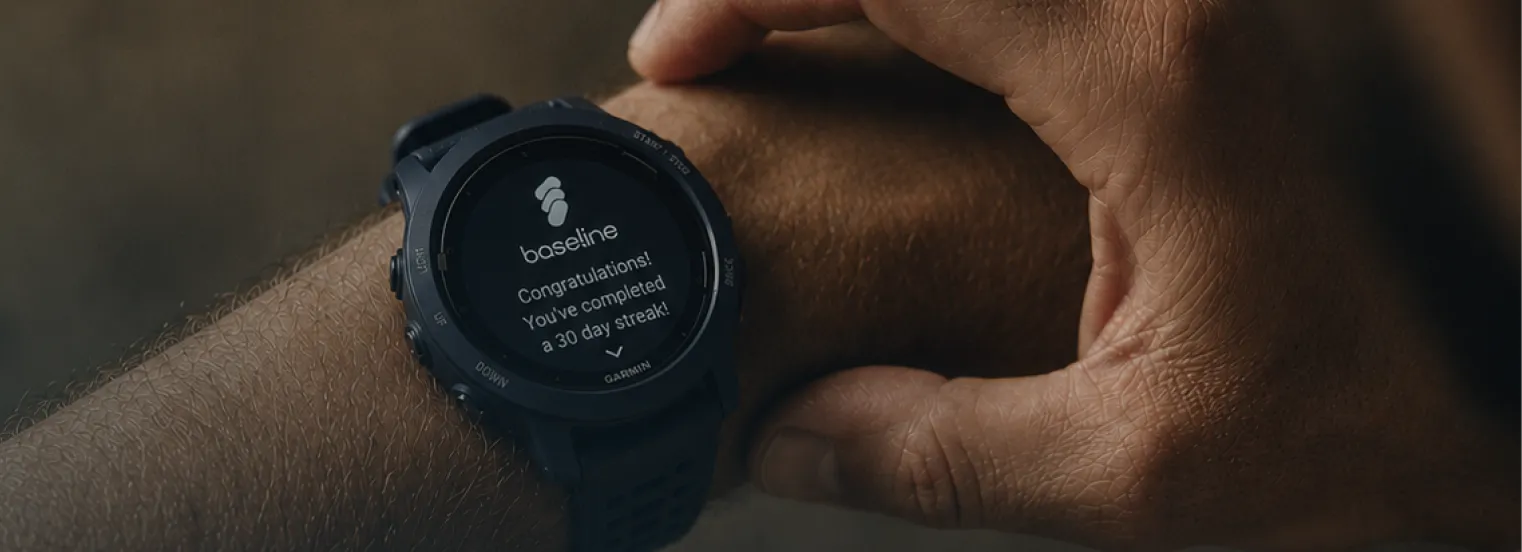
Baseline's streak system requires completion of 2 of 3 daily challenges to maintain a streak. This threshold is intentional - it's derived from loss-aversion research demonstrating that people invest disproportionate effort to protect gains they've already accumulated. Breaking the streak forfeits accumulated progress, compounding the chain of consistency that each user can be held accountable to.
Timing is part of the intervention
Challenges are delivered at your windows of highest behavioral receptivity and withheld when your recovery data indicates your body is not primed to perform. This follows the principle of progressive overload: appropriately calibrated, repeated stress does produce compounding adaptation when recovery is sufficient (Kraemer & Ratamess, 2004). The same logic applies to behavior: moderate, consistent interventions outperform intermittent high-intensity ones over time (Wood & Rünger, 2016).
Behavior is the first input within BASIC, our proprietary engine that turns every signal into action. The result is a system that adapts not just to what your body can handle, but to when it is most ready to respond.
Kraemer WJ, Ratamess NA (2004). Fundamentals of Resistance Training: Progression and Exercise Prescription.
Wood W, Rünger D (2016). Psychology of Habit.
Wearables
Your wearable generates the highest-frequency data stream in the Baseline platform, capturing physiological signals every few seconds. Baseline uses your wearable as a real-time behavioral context layer. While most platforms receive that data and return a number in isolation, Baseline receives this data and determines what it means for you - contextualized by every additional input our platform knows about you.
A recovery score without biological context is a number without meaning. An elevated resting heart rate could indicate overtraining, acute illness, a genetic predisposition to autonomic dysfunction, or other factors. Without these layers, a wearable can tell you what is happening on the surface, but it can’t tell you why.
We are wearable-agnostic and our normalization model allows users to compete regardless of device type.
What we measure across two domains: strain and resilience
Strain is the load your body has accumulated since waking, changing in real time based on physical exertion, cognitive demand, and stress. It captures what you chose to do and what your body is silently carrying: elevated resting heart rate, non-workout calorie burn, shifts in respiratory rate, current athleticism, and more. This is grounded in the concept of allostatic load - the biological wear that accumulates when demand consistently exceeds recovery capacity (McEwen, 2000; Juster et al., 2010).
Resilience is a rolling 7-day adaptive capacity score reflecting how much physiological stress your body can effectively absorb today. It is computed from HRV trend, sleep quality and debt, resting heart rate trends, respiratory rate, and training load relative to your personal baseline, weighted toward the most recent 72 hours, because your autonomic nervous system, inflammatory load, and hormonal balance respond most strongly to changes within that window (Stanley et al., 2013). Hard training only lowers your resilience score if recovery signals indicate your body wasn’t able to absorb the load.
Each morning, your Resilience score asks one question with context from the trailing seven days: how is yesterday affecting you today? As Strain rises throughout the day, you see how your choices impact your biology in real time. Your challenges adapt in real-time to both signals, making interventions biologically tuned, not just algorithmically scheduled. The part that matters most is what your wearable sees - asevery second is only meaningful when measured against what's normal, for you. That requires looking beyond surface-level data and into your biology itself, which is where our BASIC engine drives compounding returns.
Juster RP, McEwen BS, Lupien SJ. (2010). Allostatic Load Biomarkers of Chronic Stress and Impact on Health and Cognition
Stanley J, Peake JM, Buchheit M (2013). Cardiac Parasympathetic Reactivation Following Exercise



Diagnostics
Blood biomarkers are the slowest-moving but highest-signal data layer in the Baseline platform. Where wearables capture your physiology in real time, diagnostics reveal the underlying biological state that these signals are responding to.
A wearable can detect that your resting heart rate is elevated. A blood panel can tell you whether that elevation correlates to systemic inflammation, thyroid dysfunction, cortisol dysregulation, or an iron deficiency. Each of these causes requires different interventions entirely.
Baseline converts blood test data into dynamic, actionable health summaries across every major functional system. Each domain generates a continuously updated score that captures current functional state and tracks how it shifts over time.
Clinically validated, not proprietary
Every domain score is grounded in internationally-recognized scoring frameworks - Framingham Risk Score and Pooled Cohort Equations (ASCVD) for cardiovascular risk (Goff et al., 2014), CKD-EPI for kidney function (KDIGO, 2012), FIB-4 or APRI for hepatic assessment (EASL, 2021), among others - each have been validated against real-world outcomes in large patient populations and are cited directly in clinical guidelines. A physician reviewing your data will recognize the methodology immediately.
Context changes everything
The same biomarker value carries different clinical weight depending on your behavioral trends, genomic profile, and trajectory over time. A fasting glucose of 95 mg/dL means something different in someone whose HRV has been declining for three weeks. For individuals with genetic variants affecting iron metabolism (e.g. TMPRSS6), a borderline ferritin level requires a different interpretation entirely. BASIC provides a clear, unified picture for contextualized interpretation that drives impactful interventions. See BASIC example below.
Longitudinal by design
A single blood test is a snapshot. Baseline turns diagnostics into a continuous database of record - one that becomes more precise as your behavior changes, as additional wearable data comes online, and as your genomic context is layered in.
This diagnostic layer does not replace clinical judgment. It makes clinical judgment possible at a resolution that was not previously available outside a specialist's office.
KDIGO (2012). Clinical Practice Guideline for the Evaluation and Management of Chronic Kidney Disease.
EASL (2021). Clinical Practice Guidelines on non-invasive tests for evaluation of liver disease severity and prognosis.


Genomics
Your genome does not change, but its expression in relation to your behavior, blood, and biology changes constantly.
Baseline sequences your genome at 30x whole-genome coverage, the clinical standard for comprehensive variant detection (Biesecker & Green, 2014), and uses that data as a precision modifier layered across every other data stream the platform processes. This approach provides more dynamic and actionable insights compared to a standard genomic report, which is static and often benchmarks you against broader population data sets.
Population risk is not personal risk
Broad population-based studies are often touted as gold-standard in medical practice, yet, by definition, they commonly fail to address any unique person’s circumstances. Your genome doesn't replace population evidence; it sharpens it by turning population-level probability into personally relevant, testable guidance. A variant associated with elevated cardiovascular risk in a population study tells you something about probability, not about you. What’s required for one-to-one health intelligence is that variant interpreted alongside your current inflammatory markers, your HRV trend, your sleep debt, your activity load, and more.
Genomics explains what behavior cannot
Consider a user with a Scottsdale, Arizona zip code whose wearable data shows consistent outdoor activity and sufficient sun exposure by any behavioral measure but whose blood panel shows persistently low serum 25-hydroxyvitamin D (Vitamin D). Behaviorally, the data suggests compliance. Diagnostically, something is wrong. Genomic screening reveals variants in CYP2R1 and GC genes responsible for converting and transporting vitamin D. For this individual, sun exposure was never going to be sufficient - the problem is enzymatic, not behavioral. The intervention changes entirely, and so does the outcome.
This is the kind of insight that no single data layer can produce as it requires all three speaking to each other through a shared interpretive framework.
Grounded in validated science
Baseline's genomic knowledge base is anchored by internationally recognized variant repositories including GWAS Catalog (MacArthur et al., 2017), ClinVar (Landrum et al., 2016), and ClinGen (Rehm et al., 2015), among more than 30 curated sources. Only validated associations are incorporated. Every finding is classified benign, uncertain, or actionable and linked directly to established intervention guidelines. The knowledge base updates continuously as new associations are validated and reclassified.
Your genome, interpreted by BASIC, makes every other data layer more precise - and every new data point from your wearables, diagnostics, and behavior makes your genomic interpretation more actionable.
MacArthur J et al. (2017). The new NHGRI-EBI Catalog of published genome-wide association studies.
Landrum MJ et al. (2016). ClinVar: public archive of interpretations of clinically relevant variants.
Rehm HL et al. (2015). ClinGen: The Clinical Genome Resource.


BASIC
Behavior Analytics, Scientific Insights & Challenges.
Every data layer described - behavioral patterns, real-time biometrics, blood diagnostics, whole-genome sequencing - is independently meaningful. The insight that changes outcomes is what happens when all four are interpreted together, continuously, against your biology, and translated into a tangible daily action. That is what BASIC does.
BASIC is a rule-based scientific framework that transforms multi-omic health data into personalized insights, actionable challenges, and measurable outcomes. It is not a black-box algorithm, a recommendation engine that optimizes for engagement, or a probabilistic large language model - it is a fully auditable system where every output traces to specific data inputs and versioned scientific rules. When you ask why Baseline suggested something, the answer traces to specific rules and published evidence -never to a black box model with reasoning that can't be inspected.
This distinction is architecturally critical. Generative AI systems produce plausible but non-deterministic, non-reproducible, and non-auditable outputs. BASIC produces deterministic ones - the same inputs always produce the same recommendation, and every recommendation can be traced backward through the data and rules that generated it. This is the engineering foundation required for regulatory clearance as a Software as a Medical Device (SaMD) under FDA guidelines. Deterministic, reproducible, auditable outputs are a prerequisite for clinical-grade software.
Closed-loop infrastructure
BASIC operates through a continuous cycle: detect a behavioral or biological pattern, generate a personalized insight, assign a matched challenge, verify completion through objective wearable data, and measure whether your metrics improved afterward. Results flow back into the system, and interventions that produce measurable outcomes are promoted - interventions that don't are retired. The ruleset is improved over time and periodically refined as new research is validated and outcome data accumulates.
Personalization is the architecture
Every insight and challenge BASIC produces adapts simultaneously to your unique chronotype, stated health goals, genomic predispositions, and current Fitness Level Tier - the system's real-time assessment of appropriate challenge intensity. The same detected pattern generates a different intervention for different users because context changes meaning. BASIC is designed to displace the generic guidance prevalent across traditional medical care with contextualized and personalized information most relevant to you.
The system compounds
The more data BASIC accumulates about your specific biology and behavior, the more precisely it can target the interventions that produce measurable change for you, not for your demographic average, but for you personally. This is what it means to have a continuously refined, individually calibrated model of your health that gets more accurate the longer you use it - a Baseline.
BASIC Example
A 32-year-old male endurance athlete receives a ferritin result of 45 ng/mL - squarely within the standard reference range of 20–500 ng/mL. A conventional panel marks this as normal. BASIC layers in three additional signals:
- Genomic: He carries a TMPRSS6 variant associated with reduced iron absorption efficiency.
- Behavioral: Training volume has increased 30% over the past six weeks.
- Trajectory: His ferritin has dropped from 90 to 45 ng/mL across two consecutive draws.
In isolation, 45 ng/mL is unremarkable. In context, this athlete is trending toward functional iron deficiency under increased training load, compounded by a genetic predisposition to poor iron absorption. BASIC flags this trajectory and recommends intervention before performance decline, fatigue, or injury are likely to occur.
No health recommendation - from any doctor, lab, or platform - is certain, but what sets Baseline apart is what happens after the recommendation: completion is device-verified, the outcome is measured against your own baseline, and interventions that don't move your metrics are replaced by the next best-supported hypothesis.
Health is not a single test or a single day. It is small decisions you make that compound over time. When you interpret them through a framework that is precise enough to tell you which ones actually matter, you alter your health trajectory for life. We're not asking you to trust us. Let us show you the results.